
History of AI
Published on September 24, 2026 at 12:43 PM
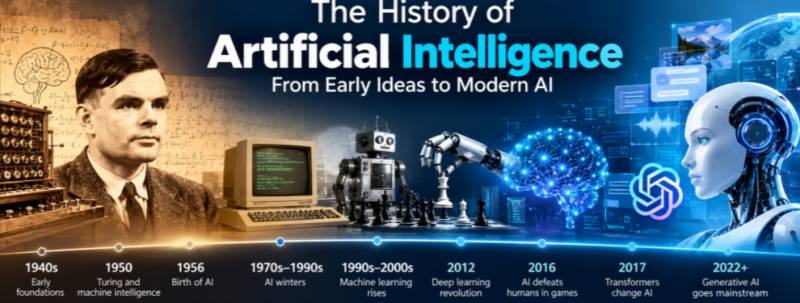
# The History of Artificial Intelligence: From Early Ideas to Modern AI
Artificial Intelligence, commonly known as AI, has become one of the most important technologies of the modern world. From chatbots and image generators to self-driving technology, recommendation systems, and intelligent software, AI is now part of everyday life.
But artificial intelligence is not a new idea. The technology we use today is the result of decades of research, experimentation, failures, and breakthroughs.
The history of AI goes back more than 70 years, with roots in mathematics, computer science, neuroscience, and philosophy.
## What Is Artificial Intelligence?
Artificial intelligence refers to computer systems designed to perform tasks that normally require human intelligence.
These tasks can include:
* Understanding language
* Recognizing images and speech
* Solving problems
* Learning from data
* Making predictions
* Generating text, images, audio, and video
* Assisting with decision-making
Modern AI systems can perform some of these tasks at a level that would have seemed impossible only a few decades ago.
## The Early Foundations of AI
The idea of creating machines that could behave intelligently existed long before modern computers.
During the 19th and early 20th centuries, mathematicians and scientists developed important ideas around logic, computation, and mechanical machines.
A major development came during the 1940s, when researchers began exploring mathematical models of artificial neurons. These early studies helped establish the idea that machines could potentially imitate aspects of the human brain.
The development of electronic computers during the same period provided the technology needed to turn these ideas into reality.
## Alan Turing and the Question of Machine Intelligence
One of the most important figures in the early history of AI was British mathematician and computer scientist **Alan Turing**.
In 1950, Turing published his famous paper *Computing Machinery and Intelligence*. Instead of simply asking, "Can machines think?", he proposed a practical test for machine intelligence.
This later became known as the **Turing Test**.
The basic idea was to determine whether a human communicating with a machine could distinguish it from another human based only on their conversation.
Turing's work became an important foundation for future research into artificial intelligence.
## 1956: The Birth of Artificial Intelligence
The year **1956** is often considered a major milestone in the history of AI.
A group of researchers gathered at the Dartmouth Summer Research Project on Artificial Intelligence in the United States.
The term **"artificial intelligence"** was associated with computer scientist **John McCarthy**, who organized the project along with other researchers.
The researchers believed that many aspects of human intelligence could potentially be described precisely enough for machines to simulate them.
This meeting helped establish AI as a formal field of academic research.
## The First AI Programs
During the 1950s and 1960s, researchers developed some of the first AI programs.
Computers were able to solve mathematical problems, play simple games, manipulate symbols, and perform logical reasoning.
Researchers also experimented with early neural networks.
One notable development was the **perceptron**, an early form of artificial neural network developed by Frank Rosenblatt in the late 1950s.
Although these systems were extremely primitive compared with today's AI, they established important concepts that would return decades later.
## The Rise of Expert Systems
During the 1970s and 1980s, researchers increasingly focused on **expert systems**.
Instead of trying to create machines that could learn everything by themselves, expert systems were designed to reproduce the decision-making process of human specialists.
These systems used large collections of rules and knowledge.
For example, an expert system could be designed to help identify potential medical conditions or recommend actions based on specific information.
Businesses became interested in these systems because they could potentially automate specialized knowledge.
However, maintaining large collections of rules was difficult, and the technology had significant limitations.
## The AI Winters
AI development has not been a straight line of continuous success.
During several periods, expectations about AI became much higher than what the available technology could actually deliver.
When researchers failed to achieve some of the promised results, funding and interest declined.
These periods became known as **AI winters**.
Despite these setbacks, research continued. Scientists continued working on machine learning, neural networks, robotics, natural language processing, and other approaches.
These years of research eventually helped create the foundation for today's AI revolution.
## Machine Learning Changes AI
A major change occurred when researchers increasingly moved away from programming every rule manually.
Instead, they began developing systems that could **learn patterns from data**.
This approach is called **machine learning**.
For example, rather than programming thousands of rules describing what a cat looks like, a machine-learning system could be trained using thousands or millions of images.
The system could then learn statistical patterns that help it recognize cats in new images.
As computers became faster and the amount of available digital data increased, machine learning became increasingly powerful.
## Deep Learning Revolution
Deep learning is a type of machine learning based on artificial neural networks with many layers.
The availability of powerful GPUs, enormous datasets, and improved algorithms dramatically accelerated deep-learning research.
One of the major milestones came in **2012**, when the AlexNet neural network achieved a major breakthrough in image recognition.
This demonstrated the potential of deep neural networks and helped accelerate investment and research in the field.
Deep learning subsequently transformed areas such as:
* Computer vision
* Speech recognition
* Translation
* Recommendation systems
* Image classification
* Natural language processing
## AI Defeats Humans at Complex Games
Games have often been used as benchmarks for artificial intelligence.
In **1997**, IBM's Deep Blue defeated world chess champion **Garry Kasparov**.
Almost two decades later, another important milestone occurred.
In **2016**, Google's DeepMind developed **AlphaGo**, an AI system that defeated professional Go player **Lee Sedol**.
Go is significantly more complex than chess in terms of the number of possible moves.
AlphaGo demonstrated how modern machine-learning techniques could tackle problems that were previously considered extremely difficult for computers.
## The Transformer Revolution
Another major breakthrough arrived in **2017** with the introduction of the **Transformer** architecture.
The research paper *Attention Is All You Need* introduced a new approach to processing sequences of information.
Transformers proved particularly effective for language-related tasks.
They became the foundation for many modern AI systems, including large language models.
The technology eventually enabled AI models to process and generate increasingly sophisticated human language.
## The Rise of Large Language Models
Large Language Models, or **LLMs**, are AI systems trained on enormous amounts of text and other data.
They can perform tasks such as:
* Answering questions
* Writing articles
* Summarizing information
* Translating languages
* Writing computer code
* Brainstorming ideas
* Analyzing documents
* Conversing with users
Models in the GPT family and other large language models demonstrated how scaling neural networks and training data could produce increasingly capable systems.
## ChatGPT Brings Generative AI to the Mainstream
The public release of **ChatGPT in November 2022** marked another major moment in the history of AI.
Although conversational AI existed before ChatGPT, its simple chat interface made advanced generative AI accessible to a very large audience.
People began using AI for education, programming, writing, business, research, customer service, marketing, and many other activities.
The rapid adoption of generative AI also triggered major discussions about AI safety, employment, copyright, misinformation, privacy, and regulation.
## AI Becomes Multimodal
Modern AI is no longer limited to text.
Many newer AI systems can work with multiple types of information, including:
* Text
* Images
* Audio
* Video
* Computer code
* Documents
This is known as **multimodal AI**.
For example, an AI system can potentially analyze an image, understand a written question about that image, and respond using natural language.
This represents a major change from earlier AI systems that were usually designed for one specific task.
## The Future of Artificial Intelligence
AI continues to develop rapidly.
Future systems may become increasingly capable of performing complex tasks, using software tools, analyzing large amounts of information, and working alongside humans.
AI is already changing industries such as:
* Healthcare
* Finance
* Education
* Software development
* Marketing
* Manufacturing
* Transportation
* Customer service
* Scientific research
At the same time, AI raises important questions about privacy, security, employment, misinformation, copyright, and responsible use.
The future of AI will therefore depend not only on technological progress but also on how businesses, governments, researchers, and society choose to use the technology.
The history of artificial intelligence is a story of ambitious ideas, technological limitations, setbacks, and remarkable breakthroughs.
From Alan Turing's questions about machine intelligence in 1950 to the birth of AI as a research field in 1956, the development of machine learning, the deep-learning revolution, Transformers, and modern generative AI, the field has evolved dramatically.
Today's AI systems are built on decades of research. What began as an academic question about whether machines could imitate human intelligence has developed into one of the most influential technologies of the 21st century.
And the story of artificial intelligence is still being written.

Written by Andrew F
Please login to comment on this post.